
Shooting Drills for Soccer: Build Confidence and Improve Finishing
Good finishing is about more than striking the ball hard. Players need to make quick decisions, create space, choose the right technique and stay composed in front of goal. Regular shooting drills can help develop these skills while keeping training competitive and enjoyable.
Try the drills below at your next session. They can be adapted for different ages and ability levels by changing the distance, pace or number of players involved.
First-Time Finishing
Set-up: Place a goal at one end of the area. A server stands near the edge of the penalty area with a supply of balls, while the shooter starts a few metres away.
How to play: The server passes the ball to the shooter, who attempts to score with one touch. Vary the direction and pace of the passes so players practise adjusting their feet and body position.
Coaching points: Encourage players to look at the target before the ball arrives, get their body over the ball and make a clean contact. Ask them to aim for a corner rather than simply shooting as hard as possible.
Dribble and Finish
Set-up: Create a starting line 15–20 metres from goal, with a cone halfway between the line and the goal.
How to play: Each player dribbles towards the cone, makes a change of direction and shoots. Players can use a feint, a turn or a quick change of pace to get past the cone.
Coaching points: Keep the ball close while approaching the cone, then take a positive touch into shooting space. Encourage players to lift their head before the shot and choose their finish based on the goalkeeper’s position.
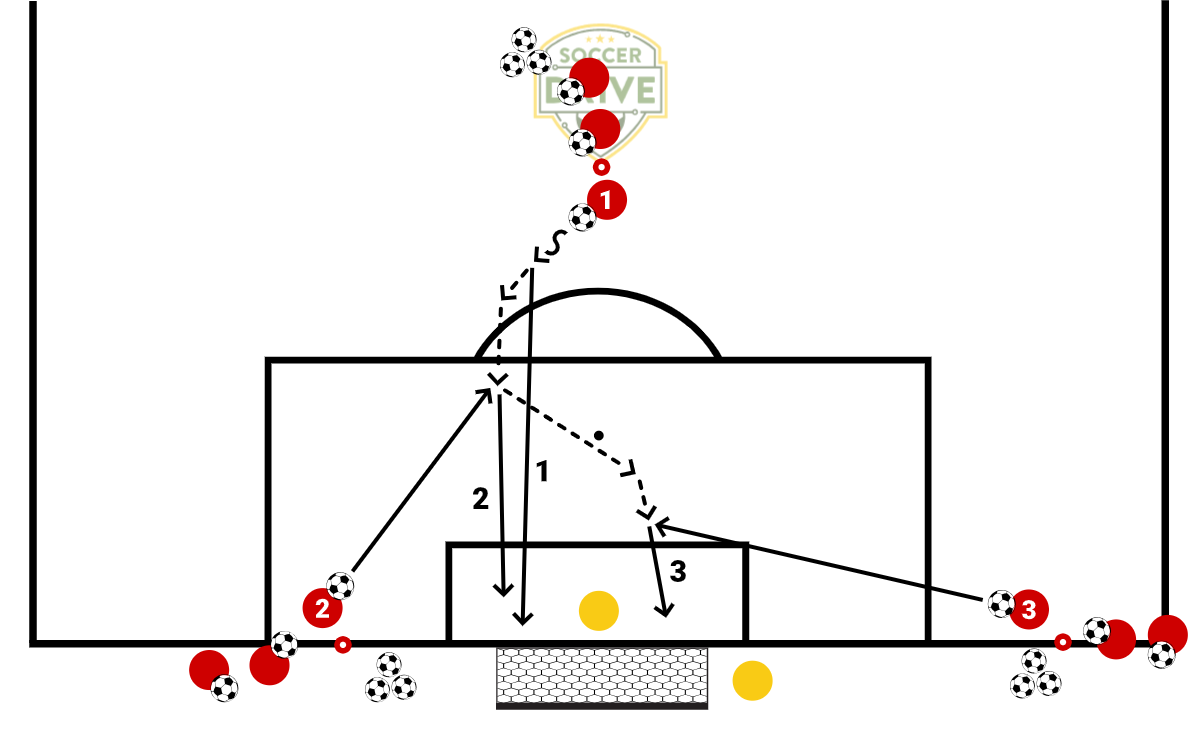
One-Two and Shoot
Set-up: Position one player as a wall passer just outside the penalty area. The shooter begins several metres away, facing the goal.
How to play: The shooter passes to the wall passer, moves into space and receives a return pass before finishing. Switch roles after each attempt.
Coaching points: The first pass should be accurate, and the movement after it should be sharp. Ask the shooter to time their run so they meet the return pass in stride and can finish without taking unnecessary touches.
Shooting Under Pressure
Set-up: Mark out a small area in front of goal. Place a server outside it, a defender inside it and a goalkeeper in goal.
How to play: The server plays a ball into the area. The attacker tries to control it and shoot while the defender applies pressure. Rotate the players regularly.
Coaching points: Attackers should protect the ball, use their first touch to move away from pressure and shoot when an opening appears. Defenders should challenge fairly and focus on delaying the shot rather than making reckless contact.
Rebound Finishing
Set-up: A goalkeeper starts in goal, with a server positioned near the edge of the area. A rebounder stands to one side of the goal, ready with extra balls.
How to play: The server shoots or passes for a shot. As soon as the goalkeeper saves or the ball rebounds, the attacker reacts and tries to finish the loose ball.
Coaching points: Players should follow in their shot without crowding the goalkeeper. Encourage quick reactions, awareness of the rebound and composure when taking a second attempt.
Finishing from Different Angles
Set-up: Set up several balls at different positions around the penalty area, including wide angles and central positions.
How to play: Players take turns shooting from each position. They can work with both feet and practise different finishes, such as a side-footed shot, a driven effort or a controlled finish across goal.
Coaching points: The best technique depends on the angle, distance and pressure. Encourage players to stay balanced and select a finish they can execute reliably.
How to Make Shooting Practice More Effective
- Keep players moving by using more than one ball or setting up multiple stations.
- Include both feet, but give players time to practise the weaker foot without rushing.
- Progress from unopposed shooting to drills involving defenders, decision-making or a goalkeeper.
- Set a clear challenge, such as scoring in a particular corner or finishing within two touches.
- Give feedback on decision-making and technique, not just whether the shot went in.
Safety and Organisation
Make sure the playing area is clear, goals are secure and players know where to queue and collect balls. Allow time for a warm-up before shooting at full pace, and organise drills so that players are not crossing into another group’s shooting lane.
Effective shooting practice combines repetition with realistic decisions. By mixing simple finishing exercises with movement, pressure and rebounds, coaches can help players become more confident and composed in front of goal.
7 Benefits of Football Shooting Drills
- Improve shooting accuracy.
- Build confidence in front of goal.
- Develop better technique.
- Practise finishing with both feet.
- Sharpen reactions and decision-making.
- Encourage teamwork and communication.
- Make training more fun and engaging.
Drawbacks of Football Shooting Drills
- Repetitive drills can become boring.
- Poor technique may be reinforced without coaching.
- Unopposed practice may not reflect match pressure.
Improve shooting accuracy.
Shooting drills help players improve their accuracy by giving them regular practice at aiming for specific areas of the goal. As they repeat different finishes, players learn to keep their balance, position their bodies well and make clean contact with the ball. Over time, this practice can help them choose their target more quickly and finish with greater confidence during matches.
Build confidence in front of goal.
Regular shooting drills help players feel more confident in front of goal by giving them frequent opportunities to practise finishing in different situations. As they become more familiar with their technique and learn to make quicker decisions, they are more likely to stay composed when chances arise in a match. A supportive training environment also encourages players to take responsibility, learn from missed shots and keep trying.
Develop better technique.
Shooting drills help players develop better technique by giving them regular, focused practice striking the ball. They can work on key details such as their body position, balance, foot placement and follow-through, while learning to use different parts of the foot for different types of finish. With consistent repetition and helpful coaching, players can build more accurate, controlled and confident shots.
Practise finishing with both feet.
Practising finishing with both feet helps players become more adaptable in front of goal. They can take a shot quickly, even when the ball arrives on their weaker side or a defender blocks their preferred angle, rather than wasting time adjusting their position. Regular drills build confidence, improve technique and give players more options when choosing where and how to finish.
Sharpen reactions and decision-making.
Shooting drills help players sharpen their reactions and decision-making by asking them to respond quickly to changing situations. Whether they are receiving a pass, spotting a gap, reacting to a rebound or choosing how to finish under pressure, players learn to assess their options and act decisively. With regular practice, they can make quicker, more confident choices in front of goal during a match.
Encourage teamwork and communication.
Shooting drills can encourage teamwork and communication by giving players opportunities to practise passing, calling for the ball and creating space for one another. Whether setting up a one-two or supplying a cross, players learn to work together and communicate clearly under pressure. These habits help build understanding on the pitch and make attacks more effective in matches.
Make training more fun and engaging.
Shooting drills can make football training more fun and engaging by giving players an active challenge and a clear goal to work towards. Adding targets, timed rounds or friendly team competitions keeps sessions lively while helping players practise their finishing. When drills are varied and enjoyable, players are more likely to stay focused, take part enthusiastically and build confidence in front of goal.
Repetitive drills can become boring.
One drawback of shooting drills is that repeating the same exercise too often can become boring, particularly for younger players. When practice feels predictable, motivation and concentration may drop, reducing the quality of each attempt. Coaches can keep sessions engaging by varying the challenges, adding realistic game situations and giving players opportunities to make their own decisions.
Poor technique may be reinforced without coaching.
A potential drawback of shooting drills is that poor technique can become a habit if players repeat shots without proper coaching. For example, incorrect body position, poor balance or an unsuitable striking technique may be reinforced with every repetition. Coaches should observe players closely, offer clear and constructive feedback, and help them practise the correct technique before increasing the speed or difficulty of the drill.
Unopposed practice may not reflect match pressure.
One drawback of shooting drills is that unopposed practice may not reflect the pressure of a real match. With no defenders closing them down and no teammates or opponents affecting their decisions, players can take their time and shoot from comfortable positions. As a result, they may find it harder to stay composed, create space and choose the right finish when faced with pressure during a game.
Tags: attacking movement, ball control, coaching points, decision-making, defenders, dribble and finish, finishing, finishing from different angles, first-time finishing, goal scoring, goalkeeper, one-two and shoot, player confidence, rebound finishing, safety and organisation, shooting drills soccer, shooting practice, shooting technique, shooting under pressure, soccer shooting drills, soccer training