
Soccer Dribbling Skills: How to Improve Your Control and Confidence
Dribbling is one of football’s most useful skills. It helps players keep possession, move into space and get past an opponent. Good dribbling is not just about performing tricks: it is about controlling the ball while staying aware of teammates, opponents and the space around you.
The basics of effective dribbling
Keep the ball close
When an opponent is nearby, use small, controlled touches so the ball stays within playing distance. Use different parts of your foot, including the inside, outside and sole, to adjust the ball’s direction. In open space, you can take a slightly bigger touch and accelerate after it.
Look up regularly
Try not to watch the ball constantly. Glance down to check your touch, then look up to see where defenders, teammates and open space are. This awareness helps you decide whether to keep dribbling, pass or shoot.
Use both feet
Developing your weaker foot makes you less predictable and gives you more options under pressure. Practise simple touches and turns with both feet, even if one side feels less comfortable at first.
Change speed and direction
A sudden change of pace can be more effective than a complicated trick. Slow down to draw in a defender, shift the ball into space, then accelerate. Changing direction with a quick touch can also help you move away from pressure.
Useful dribbling moves
- Inside cut: Use the inside of your foot to bring the ball across your body and move in a new direction.
- Outside touch: Push the ball away with the outside of your foot, then accelerate into the space.
- Step-over: Swing one foot around the front of the ball to suggest a direction, then take the ball the other way.
- Drag-back: Place the sole of your foot on the ball, pull it back and turn away from pressure.
- Body feint: Move your shoulders or hips as if going one way, then take the ball in the opposite direction.
Practise each move slowly before adding speed. The aim is to make the movement controlled and convincing, rather than to perform it for its own sake.
Drills to practise
Close-control touches
In a small area, move the ball gently between your feet using the inside and outside of each foot. Keep your touches light and your head up when possible. Continue for 30 seconds, rest, then repeat.
Dribbling through cones
Set out several cones in a straight line or a zigzag. Dribble through them using both feet, keeping the ball close. Once you can complete the course under control, try increasing your speed without letting the ball get away from you.
Turn and accelerate
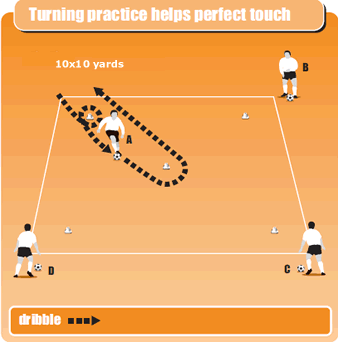
Dribble towards a marker, perform a turn such as an inside cut or drag-back, then accelerate for a few metres. Practise turning in both directions and using either foot.
One-versus-one practice
With a partner, create a small area and take turns trying to dribble past one another. The attacker should look for a change of pace or direction, while the defender applies realistic but safe pressure. Keep the area clear and agree on the rules before starting.
Common mistakes to avoid
- Taking touches that are too heavy when a defender is close.
- Looking down for too long and missing chances to pass or move into space.
- Trying tricks without a clear purpose.
- Always using the same foot or moving in the same direction.
- Dribbling into pressure when passing would be the better option.
Make your practice count
Short, regular practice sessions can be more helpful than occasional long sessions. Start with control, then gradually add speed, changes of direction and pressure from a defender. Use both feet and practise with your head up. Most importantly, make decisions: effective dribbling means knowing when to take on an opponent and when to keep the ball moving.
With patience and consistent practice, players can become more confident on the ball and better equipped to create space for themselves and their team.
Football Dribbling Skills: 8 Frequently Asked Questions
- What are the 3 basic types of dribbling in soccer?
- What are the skills for dribbling in football?
- What is the hardest skill in football?
- What are dribbling skills in soccer?
- What skill is dribbling?
- What are some common soccer tricks?
- Who is the best dribbler in soccer?
- What are the different types of dribbling skills in football?
What are the 3 basic types of dribbling in soccer?
There is no single official list, but three commonly taught types of soccer dribbling are close-control dribbling, speed dribbling and 1v1 dribbling. Close-control dribbling uses short touches to keep the ball near when opponents are close; speed dribbling uses bigger touches to move quickly into open space; and 1v1 dribbling uses feints, changes of direction or pace to beat a defender. A good player learns to switch between these depending on the situation.
What are the skills for dribbling in football?
The key skills for dribbling in football are close ball control, using both feet, keeping your head up and changing pace or direction to move past opponents. Use the inside and outside of your foot for precise touches, and practise turns, feints and changes of speed to create space. Good dribbling also involves making the right decision: keep possession, pass or take on a defender depending on the situation.
What is the hardest skill in football?
The hardest skill in football depends on the player, but many consider dribbling past an opponent at speed to be one of the most challenging. It requires close ball control, balance, quick footwork and the ability to read a defender, all while making decisions under pressure. Skills such as accurate passing, finishing and defending can be equally difficult to master, so regular practice and match experience are key to improving.
What are dribbling skills in soccer?
Dribbling skills in soccer are the techniques players use to move the ball while keeping it under control, usually with their feet. They include using different parts of the foot, changing direction or pace, and using feints to get past an opponent or find space. Effective dribbling also involves keeping your head up, protecting the ball and knowing when to pass rather than take on a defender.
What skill is dribbling?
Dribbling is a fundamental football skill that involves controlling and moving the ball with your feet while travelling across the pitch. It helps a player keep possession, find space and move past opponents using close touches, changes of direction and pace. Good dribbling also requires awareness, balance and decision-making, so players know when to carry the ball and when to pass.
What are some common soccer tricks?
Common football tricks include the step-over, where you move a foot around the ball to fake one way before going the other; the body feint, using your shoulders or hips to mislead a defender; the inside cut, which changes direction with the inside of your foot; and the drag-back, pulling the ball backwards with the sole to escape pressure. Practise each move slowly with both feet, then build up speed. The best trick is one used at the right moment to create space and keep control of the ball.
Who is the best dribbler in soccer?
There is no definitive answer, as the best dribbler in soccer depends on personal opinion and the era being considered. Lionel Messi is often named for his close control, balance and ability to beat opponents at speed, while players such as Diego Maradona, Ronaldinho and Neymar are also celebrated for their dribbling. Ultimately, the best dribbler is someone who can use skill effectively to create chances and help their team.
What are the different types of dribbling skills in football?
Football dribbling skills include close-control dribbling, which keeps the ball near your feet in tight spaces; speed dribbling, where you push the ball into open space and accelerate; and change-of-direction moves, such as cuts, turns and drag-backs, to evade a defender. Players also use feints—including step-overs and body feints—to disguise their intentions, while shielding helps protect the ball under pressure. The best skill to use depends on the space, the defender’s position and whether dribbling is the right choice in the moment.
Tags: awareness, ball control, body feint, both feet, change of direction, change of speed, close control, cone dribbling, confidence, creating space, decision-making, drag-back, dribbling moves, football skills, footwork, inside cut, one-versus-one practice, outside touch, passing, practice consistency, shooting, soccer dribbling, soccer dribbling skills, soccer drills, step-over, weaker foot